Metal Braces in Dubai: How They Work and Who They May Suit
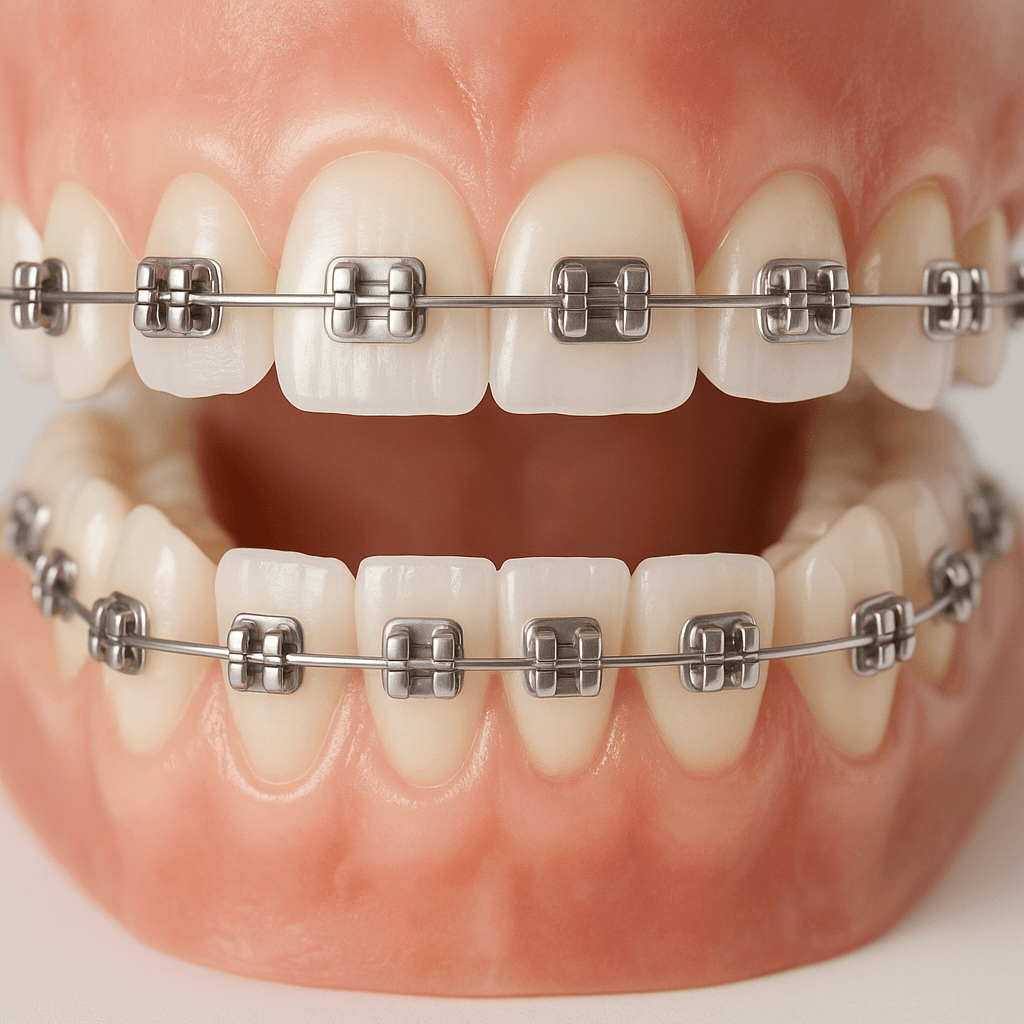
Metal braces are fixed orthodontic appliances. Brackets are
attached to the teeth and connected by an archwire that helps
guide tooth movement during treatment. Conventional metal
brackets are commonly made from stainless steel, although wires
and other appliance components may use different alloys or
materials.
[1,2]
“Metal” describes the bracket material. It does not tell you how
the wire is held in the bracket: both conventionally ligated and
self-ligating brackets can be metallic. The appropriate appliance
should therefore be chosen from your diagnosis and treatment
needs rather than from the material name alone. Metal brackets do
not, by themselves, establish faster treatment, better results,
greater effectiveness or suitability for more complex cases.
[1,2]
Bracket Material
Conventional metal brackets are commonly stainless steel.
Fixed Appliance
Brackets remain attached to the teeth during active treatment.
Treatment Needs First
Suitability should come from your treatment needs, not the
material name alone.
For broader information about fixed-brace treatment, see
Braces in Dubai.
For current price ranges and guidance on comparing quotes, see
Braces Cost in Dubai.
What Are Metal Braces?
Metal braces use brackets that remain attached to the teeth during
active treatment. An archwire is engaged in the bracket slots and is
used as part of the orthodontic mechanics that guide the teeth
towards their planned positions.
[1,2]
Brackets, the archwire and the parts that hold the wire in place
each have a different role.
🦷
Different parts do different jobs
The brackets are attached to the teeth, while the archwire works
with them to guide tooth movement. In conventional braces, small
elastic or metal ties may be used to hold the wire in the
brackets. Other brace systems use a built-in mechanism instead.
These parts do not all have to be made from the same material.
Conventional metal brackets are commonly stainless steel, while
wires, ties and other components may use different materials.
[1]
⚙️
What is actually made from metal?
Conventional metal brackets are commonly made from stainless
steel. Other parts of the appliance may be made from different
alloys or materials. If you have a particular material concern,
ask what is used in the specific brace system being recommended
for you.
[1]
▣
Bracket
Attached to the tooth during active treatment.
⟶
Archwire
Works with the brackets to help guide tooth movement.
Key point:
“Metal braces” describes the brackets, not necessarily every part of
the appliance.
Metal Does Not Mean “Conventional”
“Metal” describes what the bracket is made from. “Conventional” and
“self-ligating” describe how the wire is held in the bracket.
⚙️
Metal describes the bracket material
A bracket can be metallic whether it is part of a conventional
brace system or a self-ligating one. The word “metal” therefore
does not tell you how the wire is held in place.
[1,2]
⛓️
The wire can be held in different ways
Conventional metal braces may use small elastic or metal ties to
hold the archwire in the brackets. Self-ligating brackets use a
built-in part of the bracket instead. Self-ligating brackets can
also be metal.
One way of holding the wire is not automatically faster, more
comfortable, more effective or linked with fewer appointments.
Those outcomes depend on more than the bracket design alone.
[1,2]
If you want to understand one named self-ligating system in more detail,
see the
Damon braces guide.
Metal Braces vs Ceramic Braces: What Actually Differs?
The main differences are how the brackets look and the materials they
are made from. Neither material is automatically better for every
patient or every treatment plan.
◉
Appearance
Metal brackets on the outer surfaces of the teeth are generally
more noticeable than clear or tooth-coloured ceramic brackets.
Ceramic brackets may therefore appeal to someone who wants their
braces to be less visible, provided they are also suitable for the
treatment plan.
[3]
◆
Material
Metal is less brittle than ceramic. That does not mean metal
brackets will always last longer during treatment, never break or
produce better orthodontic results.
[3,4]
Does one material perform better overall?
Bracket material alone does not tell you which option will be faster,
more effective, more comfortable or easier to keep clean.
Studies comparing breakage and bracket failure have not found one
material that consistently performs better in every setting. What
happens in practice can depend on the particular bracket system and
the treatment being carried out.
[6,7]
If you are considering ceramic brackets, see
Ceramic Braces in Dubai
for more on appearance, staining, suitability and care.
Are Metal Braces Stronger or More Durable?
Metal brackets are less brittle than ceramic brackets. But that does
not mean they will always last longer or have fewer problems during
treatment.
[3,4]
◆
The material itself
Metal is less brittle than ceramic, which means it is less prone
to brittle fracture as a material.
◉
What happens during treatment
Metal brackets can still break or come loose from the tooth.
Bracket design, bonding, how the appliance is used and the
circumstances of treatment can all affect what happens in practice.
So are metal brackets more durable overall?
Not in every situation. Studies comparing metal and ceramic brackets
have not shown one material to have fewer bracket failures in every
setting. One study found fewer failures with metal brackets, while
another found the opposite.
[6,7]
Material
Metal is less brittle than ceramic.
In treatment
That does not mean metal brackets will always break or come loose
less often.
If breakage is a concern for you, ask how the particular bracket
system being recommended is expected to perform in your treatment.
Are Metal Braces Faster?
Metal braces are not automatically faster than ceramic braces.
Treatment time depends on much more than the material used for the
brackets.
⇄
Friction can differ between brace systems
The way a bracket and archwire interact can affect friction.
Different bracket designs and wire combinations can behave
differently, including within ceramic brace systems.
[4,5]
⏱
Lower friction does not automatically mean faster treatment
A difference in friction between brackets does not tell you how long
your whole treatment will take.
Treatment time depends on your diagnosis, the tooth movements that
are needed, your treatment goals and how treatment progresses.
Friction alone should therefore not be used to promise that metal
braces will finish treatment faster.
[4,5]
What matters for you:
ask for a treatment-time estimate based on your own diagnosis and
treatment plan rather than choosing a bracket material because it is
described as “faster.”
[4,5]
Who May Be Suitable for Metal Braces?
Metal braces may be an option when fixed braces suit your diagnosis
and treatment plan. The choice should be based on what needs to be
corrected, your treatment goals and your individual needs rather than
on age or bracket material alone.
🦷
Your teeth and bite
The tooth movements and bite correction you need are an important
part of deciding which type of braces may suit you.
◎
Your oral health
The health of your teeth and gums should be considered before
starting treatment with fixed braces.
⚙️
What your treatment needs to achieve
Some treatment plans need particular types of tooth movement or
brace control, which can influence the brace system recommended.
◉
How visible you want your braces to be
Metal braces are more noticeable than some alternatives, so
appearance and your personal preferences may also affect the choice.
◇
Any relevant allergies or sensitivities
Tell the treating team if you have a known or suspected metal
allergy so the materials in the proposed braces can be considered.
✓
Your treatment goals
The brace system should fit the goals of your treatment rather than
being chosen simply because the brackets are metal.
There is no single “best” brace for everyone.
Metal braces are not automatically the best choice for severe cases,
for children or for every patient. Suitability depends on the
individual treatment plan.
If you want to compare the wider range of fixed-brace options, see
Braces in Dubai.
Nickel Allergy and Metal Braces
Some orthodontic alloys contain nickel. If you know or suspect that
you have a nickel allergy, tell the treating team before your braces
are chosen. This does not mean metal braces are unsafe for everyone.
[8]
◇
If you know or suspect you have a nickel allergy
Tell the treating team before the braces are selected or fitted.
If jewellery, watches or other metal items have caused a skin
reaction in the past, mention that too.
Not everyone considering metal braces needs allergy testing. Whether
any further assessment is needed depends on your own history and
circumstances.
[8]
↔
Can another material be considered?
Sometimes. If nickel is a concern, the treating team can discuss
whether another suitable material or brace system is available for
your treatment. The best alternative depends on what your treatment
needs to achieve.
[8,9]
What matters most:
mention any known or suspected metal allergy before treatment so the
materials in your proposed braces can be considered properly.
Metal Braces and MRI
Metal braces do not automatically mean you cannot have an MRI.
The important question is whether the braces could affect the images
needed for your particular scan.
[11,12]
◉
Braces can affect MRI image quality
Metal parts of an orthodontic appliance can sometimes distort part
of an MRI image. Stainless-steel components may be particularly
relevant when the area being scanned is close to the head or neck.
[11,12]
This is mainly an image-quality issue. It is different from saying
that metal braces are automatically dangerous during an MRI.
✓
Tell the MRI team before your scan
If you have fixed braces and need an MRI, tell the MRI or radiology
team beforehand. They can consider what part of the body is being
scanned, the materials in your braces and whether the appliance is
likely to affect the images they need.
[11,12]
Do metal braces need to be removed before MRI?
Not always. There is no rule that every bracket, wire or other
component must be removed before every MRI.
Sometimes the imaging team may ask for a component to be removed
temporarily if it would interfere with the area they need to see.
In other cases, nothing may need to be removed. The decision should
be made for the specific scan by the teams looking after you.
[11,12]
What Does Treatment With Metal Braces Involve?
Treatment with metal braces follows the usual stages of fixed-brace
treatment: planning, fitting the braces, monitoring progress and
retention after the braces are removed.
1
Assessment and planning
Treatment usually starts with an orthodontic assessment, diagnosis
and a plan for the tooth and bite changes that are needed.
2
Fitting the braces
Once the treatment plan is agreed, brackets are attached to the
teeth and an archwire is placed to begin guiding tooth movement.
3
Progress checks and adjustments
Your orthodontist checks how treatment is progressing and makes
adjustments when needed.
4
Braces removal and retainers
When active treatment is finished, the braces are removed and the
retention phase begins to help maintain the result.
How often will appointments be needed?
There is no single schedule that applies to everyone with metal
braces. Visit timing depends on the stage of treatment and what needs
to be checked or adjusted.
For a broader overview of fixed-brace treatment, see
Braces in Dubai.
Living With Metal Braces
Because metal braces stay attached to the teeth during treatment,
looking after the braces and keeping them clean becomes part of your
daily routine.
🍎
Eating and protecting your braces
Hard, sticky or difficult-to-bite foods can damage brackets or
wires. Follow the advice given for your particular braces, including
how to adapt or cut certain foods when needed.
[10]
✦
Cleaning around brackets and wires
Brackets and wires create extra areas where plaque and food can
collect. Cleaning carefully around the brackets, wire and gumline
helps you look after your teeth and gums during treatment.
[10]
⚠
What if a bracket becomes loose or a wire causes a problem?
Contact the treating team for advice rather than trying to repair
or reposition the braces yourself. They can tell you whether the
problem needs prompt attention or can safely wait until your next
planned visit.
Good cleaning matters with any fixed braces.
Metal brackets should not be assumed to be automatically cleaner,
dirtier, better or worse for the gums simply because they are metal.
How Long Does Treatment With Metal Braces Take?
The fact that the brackets are metal does not, by itself, determine
how long treatment will take.
⏳
Treatment time depends on your plan
How long treatment takes depends on your diagnosis, the tooth
movements and bite correction needed, your treatment goals and
how treatment progresses over time.
◉
There is no single timeframe for metal braces
Metal braces are not automatically faster than ceramic braces,
and a general treatment range may not reflect your own case. The
most useful estimate is the one based on your individual
assessment and treatment plan.
What Do Metal Braces Cost in Dubai?
Metal-braces pricing in Dubai can vary with the treatment plan,
the complexity of care and what is included in the quote.
For current price ranges and detailed guidance on comparing quotes,
see LumiQuest’s dedicated braces cost guide.
◉
Compare the full treatment quote
A headline price does not always tell you what is included.
Ask for a written quote that makes the total treatment scope
clear.
✓
Check what is included
Ask whether records, routine monitoring, repairs, retainers
and other treatment-related items are included in the quoted
price or charged separately.
↗
Look beyond the bracket material
The final fee can depend on more than whether the brackets are
metal. Your treatment needs and the services included in the
plan can also affect the overall cost.
Looking for current metal-braces pricing?
See
Braces Cost in Dubai
for current price ranges and guidance on comparing orthodontic quotes.
Questions to Ask at Your Consultation
A consultation is a good time to understand why a particular brace
system is being recommended and what treatment would involve for you.
These questions can help you prepare.
1
Why are metal braces being recommended for me?
Ask which parts of your diagnosis and treatment goals make this
appliance a suitable option.
2
Is this a conventional or self-ligating metal bracket?
“Metal” describes the bracket material, so it is useful to ask how
the archwire is held in the bracket and what system is actually
being proposed.
3
Are there other suitable brace options for my case?
If more than one option is clinically appropriate, ask how they
differ in visibility, materials, practical care and treatment
considerations.
4
What treatment duration do you expect for my case?
Ask for an estimate based on your diagnosis and planned treatment,
rather than relying on a generic metal-braces timeframe.
5
What should I know about cleaning, eating and breakages?
Ask how to clean around the appliance, which foods or habits could
damage it, and what to do if a bracket loosens or a wire causes a
problem.
6
Do any material or allergy concerns apply to me?
Mention any known or suspected metal allergy and ask what materials
are present in the proposed appliance.
7
What is included in the treatment quote?
Ask whether records, routine monitoring, repairs, retainers and
other treatment-related items are included or charged separately.
8
What happens after the braces come off?
Ask which retainer approach is planned, how long retention is
expected and what follow-up will be needed.
You do not need to ask every question in one visit. The aim is to
leave the consultation understanding the proposed appliance, why it
may suit your treatment plan, what the process involves and what the
written quote includes.
Retainers After Metal Braces
When active treatment finishes and the braces are removed, retention
helps maintain the corrected tooth positions.
[13]
✓
Retention is part of treatment
Teeth can move after orthodontic treatment, so the retention phase
is an important part of maintaining the result rather than simply
an optional final step.
[13]
◉
Your retainer plan should be individual
The type of retainer, how it should be worn and the follow-up plan
should reflect your treatment and clinical needs.
[13]
↻
Know what to do if something changes
Before treatment finishes, ask what to do if a retainer is lost,
damaged or stops fitting properly, and what follow-up is recommended.
For more detail on retainer types, wear and long-term aftercare, see
Retainers in Dubai.
Metal Braces FAQs
Clear answers to common questions about metal braces, materials,
treatment and safety.
What are metal braces made from?
Conventional metal brackets are commonly made from stainless
steel. The archwire, ties and other parts may use different
alloys or materials, so not every part of a metal-brace system
is necessarily stainless steel.
Are all metal braces conventional braces?
No. “Metal” describes what the bracket is made from.
“Conventional” and “self-ligating” describe how the archwire is
held in the bracket. A self-ligating bracket can also be metal.
Are metal braces stronger or more durable than ceramic braces?
Metal is less brittle than ceramic, but that does not mean metal
brackets will always last longer or come loose less often during
treatment. Studies comparing metal and ceramic brackets have not
shown one material to perform better in every setting.
Are metal braces faster than ceramic braces?
Not automatically. Friction can differ between brace systems,
but that alone does not determine how long treatment will take.
Treatment time depends on your diagnosis, treatment plan, the
tooth movements needed and how treatment progresses.
Can you have metal braces if you have a nickel allergy?
A known or suspected nickel allergy can matter because some
orthodontic alloys contain nickel. Tell the treating team about
any relevant allergy history before your braces are chosen.
Not everyone needs allergy testing, and the most suitable
alternative depends on the individual treatment plan.
Can you have an MRI with metal braces?
Metal braces do not automatically mean you cannot have an MRI.
They can affect image quality in some scans, especially around
the head and neck, so tell the MRI or radiology team that you
have fixed braces. Whether anything needs to be removed depends
on the specific scan.
How much do metal braces cost in Dubai?
Metal-braces pricing can vary with the treatment plan and what is
included in the quote. For current price ranges and guidance on
comparing orthodontic quotes, see LumiQuest’s
Braces Cost in Dubai
guide.
About This Guide
◉
Independent dental guidance
LumiQuest Dental Circle is an independent dental guidance platform.
It is not a dental clinic or a provider-ranking marketplace.
This guide is designed to help you understand metal braces,
important material and safety considerations, and useful questions
to ask before treatment.
It does not replace an individual orthodontic assessment, diagnosis
or treatment plan.
✓
Editorial and clinical review
Written by
LumiQuest Editorial Team
Clinical review by
Dr. Joe Feghali — Orthodontist and Founder,
LumiQuest Dental Circle
Clinical review date
11 September 2026
References
References were selected for the specific clinical claims cited
in this guide.
1
British Orthodontic Society.
Conventional Fixed Braces.
Current professional and patient guidance.
British Orthodontic Society
.
Karamouzos A, Athanasiou AE,
Papadopoulos MA.
Clinical characteristics and properties of ceramic brackets:
A comprehensive review.
American Journal of Orthodontics and Dentofacial Orthopedics.
1997;112:34–40.
DOI:
10.1016/S0889-5406(97)70271-3
.
PMID:
9228839
.
5
AlSubaie M et al.
Study of force loss due to friction comparing two ceramic
brackets during sliding tooth movement.
Journal of Orofacial Orthopedics.
2016;77:334–340.
DOI:
10.1007/s00056-016-0038-0
.
PMID:
27384715
.
6
Scribante A et al.
Metallic vs Ceramic Bracket Failures After 12 Months of
Treatment: A Prospective Clinical Trial.
International Dental Journal.
2024;74:1371–1377.
DOI:
10.1016/j.identj.2024.04.023
.
PMID:
38744578
.
7
Ogiński T et al.
A Clinical Comparison of Failure Rates of Metallic and Ceramic
Brackets: A Twelve-Month Study.
2020;9725101.
DOI:
10.1155/2020/9725101
.
PMID:
32382584
.
8
Gölz L, Papageorgiou SN, Jäger A.
Nickel hypersensitivity and orthodontic treatment:
a systematic review and meta-analysis.
Contact Dermatitis.
2015;73:1–14.
DOI:
10.1111/cod.12392
.
PMID:
25880885
.
9
Pazzini CA et al.
Allergic reactions and nickel-free braces:
a systematic review.
Brazilian Oral Research.
2011;25:85–90.
DOI:
10.1590/S1806-83242011000100015
.
PMID:
21359455
.
10
American Association of Orthodontists.
Fixed-appliance care and oral-hygiene guidance.
Current professional and patient guidance on cleaning,
eating and caring for braces.
American Association of Orthodontists
.
11
Dobai A et al.
MRI compatibility of orthodontic brackets and wires:
systematic review article.
BMC Oral Health.
2022.
DOI:
10.1186/s12903-022-02317-9
.
PMID:
35854295
.
12
Johannsen KM et al.
Magnetic resonance imaging artefacts caused by orthodontic
appliances and/or implant-supported prosthesis:
a systematic review.
Oral Radiology.
2023;39:394–407.
DOI:
10.1007/s11282-022-00652-9
.
PMID:
36178613
.
13
Al-Moghrabi D, Littlewood SJ, Fleming PS.
Orthodontic retention protocols:
an evidence-based overview.
British Dental Journal.
2021;230:770–776.
DOI:
10.1038/s41415-021-2954-7
.
References were selected for the specific clinical claims cited in
this guide. Different sources address different questions, including
bracket materials, metal-versus-ceramic comparisons, nickel sensitivity,
MRI considerations, fixed-brace care and retention.
Tell Us What You're Looking For
Describe your dental concern or goal. We'll review your enquiry and follow up using the contact details you provide.
LumiQuest guidance is currently free for patients; clinic consultation and treatment charges are separate.
We ask for your consent before sharing your identifiable information with a clinic.
Enquiring about dental care for a child? Please have a parent or legal guardian submit the enquiry. We may ask for the child's age during follow-up if it is relevant to understanding the care being sought.
Manage Consent
LumiQuest uses necessary cookies and similar technologies for website functionality and security. With your permission, we also use Google Analytics to understand how visitors use our website. You can accept or deny optional analytics cookies, view your preferences, and change your choice later using Manage consent. Read our Privacy Policy for more information.
Functional
Always active
The technical storage or access is strictly necessary for the legitimate purpose of enabling the use of a specific service explicitly requested by the subscriber or user, or for the sole purpose of carrying out the transmission of a communication over an electronic communications network.
Preferences
The technical storage or access is necessary for the legitimate purpose of storing preferences that are not requested by the subscriber or user.
Statistics
With your permission, we use Google Analytics to understand visits and interactions with our website. Analytics cookies are optional, and you can change your choice at any time.The technical storage or access that is used exclusively for anonymous statistical purposes. Without a subpoena, voluntary compliance on the part of your Internet Service Provider, or additional records from a third party, information stored or retrieved for this purpose alone cannot usually be used to identify you.
Marketing
The technical storage or access is required to create user profiles to send advertising, or to track the user on a website or across several websites for similar marketing purposes.