- Invisalign. What to expect in your first two weeks with Invisalign clear aligners. April 2026. Source

Reading Invisalign reviews can help you understand what other people noticed during treatment and what questions may be worth asking before you start.
LumiQuest analysed 855 eligible review records linked to Dubai Invisalign experiences. Reviews can highlight recurring experiences around communication, appointments, timing, costs and follow-up.
They cannot prove that Invisalign will work for your case, confirm that another person’s result was clinically successful or identify the “best” clinic.
Three themes were especially useful for understanding what patients chose to write about:
| What reviewers discussed | Reviews in our analysis | Why it may matter to you |
|---|---|---|
| Communication | 334/855 (39.06%) | Clarify how questions are handled and who you contact between visits |
| Monitoring and appointments | 157/855 (18.36%) | Understand how progress and unexpected problems will be reviewed |
| Duration expectations | 129/855 (15.09%) | Ask what your proposed timeline assumes and how changes will be explained |
Among the 855 review records analysed, Communication appeared in 334 records (39.06%), Monitoring / appointment experience in 157 (18.36%), and Duration expectations in 129 (15.09%).
A single review can contain more than one theme. These percentages therefore describe what appeared in the analysed review records, not the proportion of Dubai Invisalign patients who experience each issue.
A very positive review can be useful. So can a complaint. Neither is a clinical verdict.
A review may combine comments about:
That matters when you read phrases such as “amazing result,” “best decision” or “worth every dirham.”
A useful question is:
Communication was one of the most frequently discussed themes in the analysis.
Instead of relying on “great communication” or “poor communication” as a verdict on a provider, turn those comments into practical questions:
The point is not to predict your experience from someone else’s review.
It is to make sure you understand how your own treatment will be managed.
Communication and appointment experiences appeared often enough to make contact routes, responsibility for follow-up and continuity useful issues to clarify before treatment.
The review evidence does not show that better communication causes a better orthodontic outcome, or that a provider with more positive communication comments is clinically superior.
The practical value of this finding is the questions it prompts patients to verify for their own treatment.
Reviews may mention wearing the aligners, eating, cleaning, speech, attachments or discomfort. Those comments can help you identify practical questions, but another patient’s routine should not become your treatment instructions.
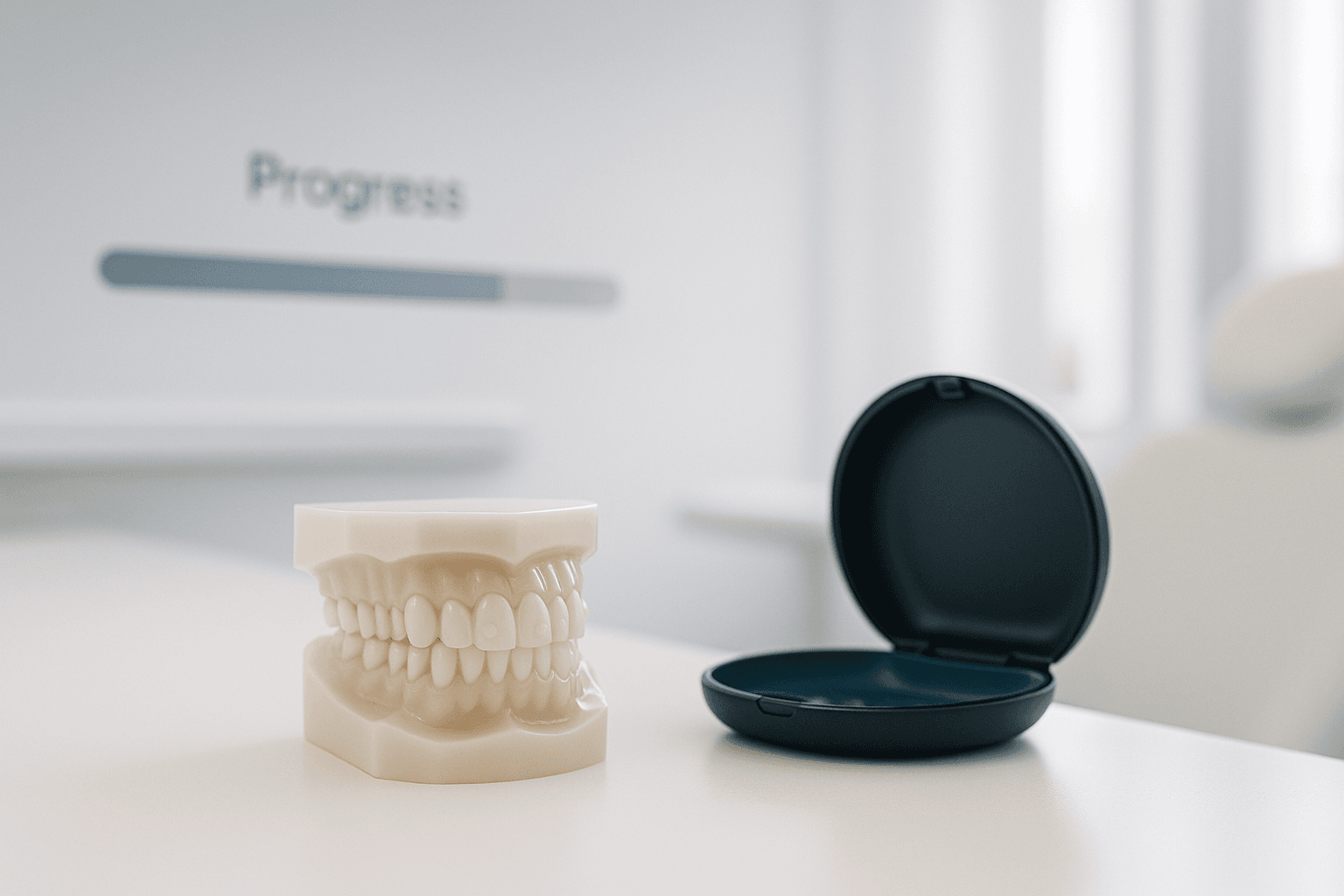
If a reviewer talks about difficulty keeping up with aligner wear, remember that Invisalign is commonly prescribed for about 20 to 22 hours per day, but your own treatment instructions take priority. 1
For wear, meals, cleaning, attachments and day-to-day care, see the full Invisalign treatment guide.
A reviewer’s speech-adaptation time, cleaning routine or experience with attachments should not be treated as a rule for you.
If discomfort is severe or persistent, contact your treating team. 2
Do not rely on another patient’s pain score, timeline or home remedy to decide what you should do.
A review saying that someone’s aligner broke, was lost or stopped fitting tells you what happened to that reviewer. It cannot tell you what to do with your own aligner.
If yours is lost, damaged or no longer fitting properly, contact your treating team.
Do not skip ahead or change the aligner sequence unless the treating team advises you to. 2
For more detail, see guidance on Invisalign problems and monitoring.
A review may say treatment matched the original plan closely. Another may describe delays, extra aligners or changes along the way.
Those experiences should not be used to predict what your own treatment will require.
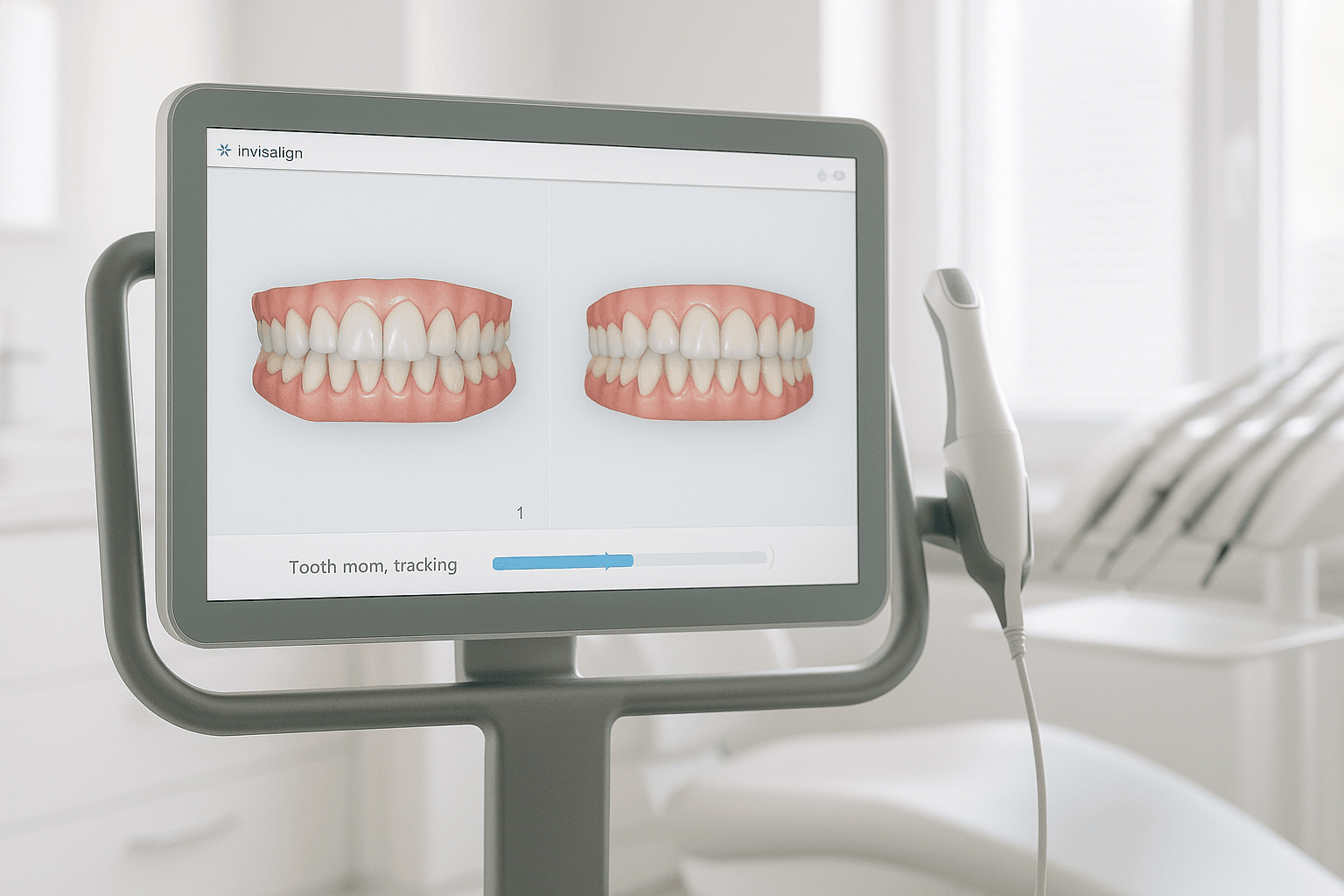
A digital simulation shows the intended plan. It is not a guarantee that teeth will move exactly as shown.
Monitoring compares actual treatment response with the plan. If further movement is needed, additional aligners may sometimes be considered. 3
What a review cannot tell you is:
Ask how progress will be checked, how you will be told if the plan needs to change and what any additional stage means for your treatment scope.
For the full clinical explanation, see Invisalign planning and monitoring guidance.
The review analysis does not establish how often Invisalign patients need additional aligners or treatment changes.
Clinical evidence is used only for the safety and interpretation bridge on this page: a digital plan is not a guarantee of exact movement, actual response requires monitoring, and further aligners may sometimes be considered if more movement is needed.
A review saying Invisalign was “worth it” tells you how that reviewer valued their experience.
It does not tell you whether:
Reviews about unexpected costs or good value should prompt you to check what your own written quote includes, particularly:
A starting price, deposit or instalment is not automatically the full treatment total.
For detailed Dubai Invisalign prices, packages and inclusions, see Invisalign costs and quote inclusions in Dubai.
Cost / quote clarity appeared in 34 of 855 review records (3.98%). Price / value perception appeared in 48 of 855 (5.61%).
These findings describe what reviewers discussed. They do not establish Dubai Invisalign prices, prove that a quote was fair or show that treatment was cost-effective.
Comments such as “worth it” remain subjective. Quote inclusions and possible additional charges should be checked against the patient’s own written proposal.
A retainer comment can highlight an important question for later in treatment, but one person’s retainer problem does not tell you what your own retention plan should be.
If reviews make you concerned about aftercare, clarify:
For the full retention and retainer guidance, see our guide to retainers and aftercare.
Reviews can tell you about other people’s experiences.
They cannot diagnose your case or decide whether Invisalign is appropriate for you.
Suitability depends on your own diagnosis, the tooth and bite movements required, your treatment goals and whether the proposed plan is appropriate for those needs. 5
So a reviewer who had an excellent experience does not prove Invisalign is right for you, and a reviewer who had problems does not prove it is wrong for you.
If you are deciding whether Invisalign fits your case, see Invisalign suitability and treatment guidance.
The review analysis describes reported experiences and recurring themes.
It can help identify questions about:
It cannot establish:
Clinical suitability and treatment decisions require assessment of the individual case.
You do not need to remember every review statistic.
A better goal is to turn the themes you noticed into questions you can verify.
For detailed treatment and suitability questions, use the Invisalign treatment and suitability guide.
LumiQuest analysed 855 eligible review records dated from 1 January 2022 to 15 September 2026 across Google, Doctify, Trustpilot and Reddit.
The unit is a review record, not a confirmed unique patient. The analysis is therefore not a representative survey of Dubai Invisalign patients.
The source mix is uneven. Google contributed 751 of the 855 eligible records, so the findings should not be read as though all four platforms contributed equally.
LumiQuest used defined eligibility, source, duplicate-handling and coding rules.
The final Google dataset was produced by filtering a much larger set of retrieved reviews. LumiQuest retrieved 164,453 Google review records. Of these, 133,941 fell within the study period, 1,253 were identified as possible Invisalign-related reviews, and 751 met the final Google eligibility rules.
These numbers describe the screening process. They do not mean that 164,453 reviews were Invisalign reviews or that all retrieved reviews were analysed as Invisalign experiences.
The other platforms used their own source-specific collection and screening processes, so their upstream raw counts are not combined with Google into a single comparable funnel.
The final analysis contains 855 eligible review records from:
The 855 eligible review records produced 3,688 coded statements across the analysis.
The reviews represented 91 provider groups from the 186-group provider frame. The three largest contributing groups supplied 282 of the 855 records (32.98%).
Those concentration checks help show whether findings depend heavily on particular sources or providers. They do not make the dataset representative of all Dubai Invisalign patients or providers.
It does not:
Clinical guidance used for the compact safety bridges on this page comes from separately reviewed clinical evidence, not from review anecdotes.
Reviews are useful for identifying experiences and questions worth investigating, but keep the following in mind:
Use reviews to help you ask better questions.
Use your own diagnosis, treatment plan and written quote to make treatment decisions.
Need the full Invisalign treatment explanation?
How Invisalign treatment worksComparing prices, packages or inclusions?
Invisalign costs and quote inclusions in DubaiDeciding between Invisalign and braces?
Compare Invisalign and bracesWant the full retention guide?
Understand retainers and aftercareLumiQuest can help you understand what to clarify before treatment and navigate toward potentially suitable dentists or clinics.
Bring the questions that remain unclear, such as who will monitor treatment, how changes are communicated or what your quote includes.
LumiQuest Dental Circle is an independent dental guidance platform. It does not provide orthodontic treatment, publicly rank providers or guarantee that a particular provider will be suitable for you.
Who prepared and reviewed this analysis, and when the evidence and study were reviewed.
The review findings on this page come from LumiQuest’s own review analysis. The sources below support the separate clinical guidance used where the page explains how to interpret a review safely.
Describe your dental concern or goal. We'll review your enquiry and follow up using the contact details you provide.
LumiQuest guidance is currently free for patients; clinic consultation and treatment charges are separate.
We ask for your consent before sharing your identifiable information with a clinic.