Invisalign in Dubai: How Treatment Works and Who It May Suit

Invisalign is a branded clear-aligner system that uses a series of removable aligners to move teeth according to a treatment plan. Suitability depends on your diagnosis, the tooth movements and bite correction required, your treatment goals, and whether you can wear the aligners as prescribed. Another orthodontic appliance, additional treatment measures or a different sequence of care may sometimes be more appropriate. [ 1, 2 ]

Because the aligners are removable, they can be taken out for meals and for cleaning your teeth. Treatment still requires consistent wear and regular clinical monitoring. Some plans may also use small tooth-coloured attachments, elastics, or carefully planned space between certain teeth.

Independent guidance LumiQuest Dental Circle is an independent dental guidance platform. We are not a clinic, public directory or paid-ranking marketplace.
Understand Invisalign costs See current Dubai pricing evidence and what to check in a written Invisalign quote. Invisalign cost in Dubai →
Invisalign or braces? Compare how the two treatment approaches differ and what may matter when discussing your own case. Compare Invisalign and braces →
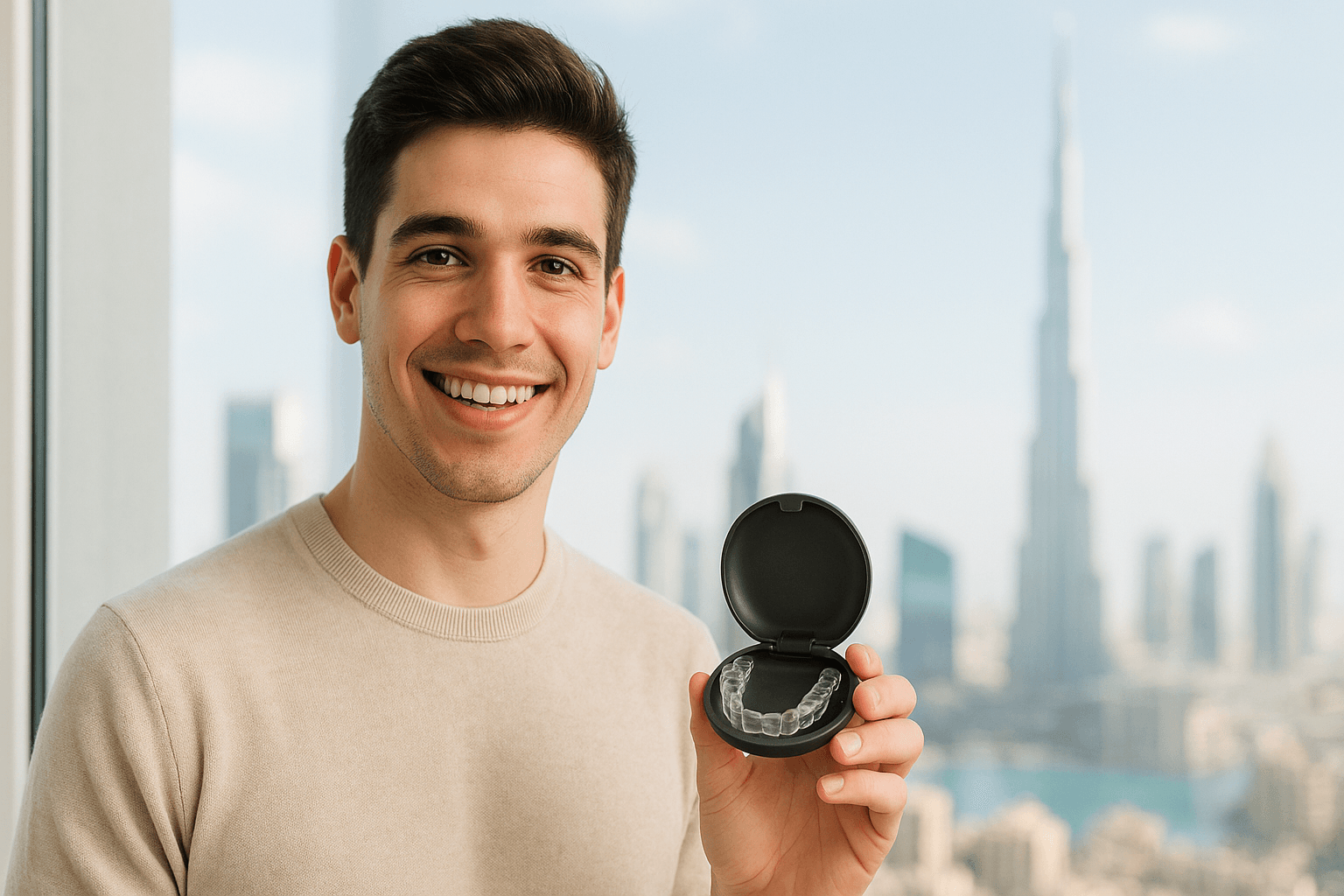
Patient holding a clear aligner case
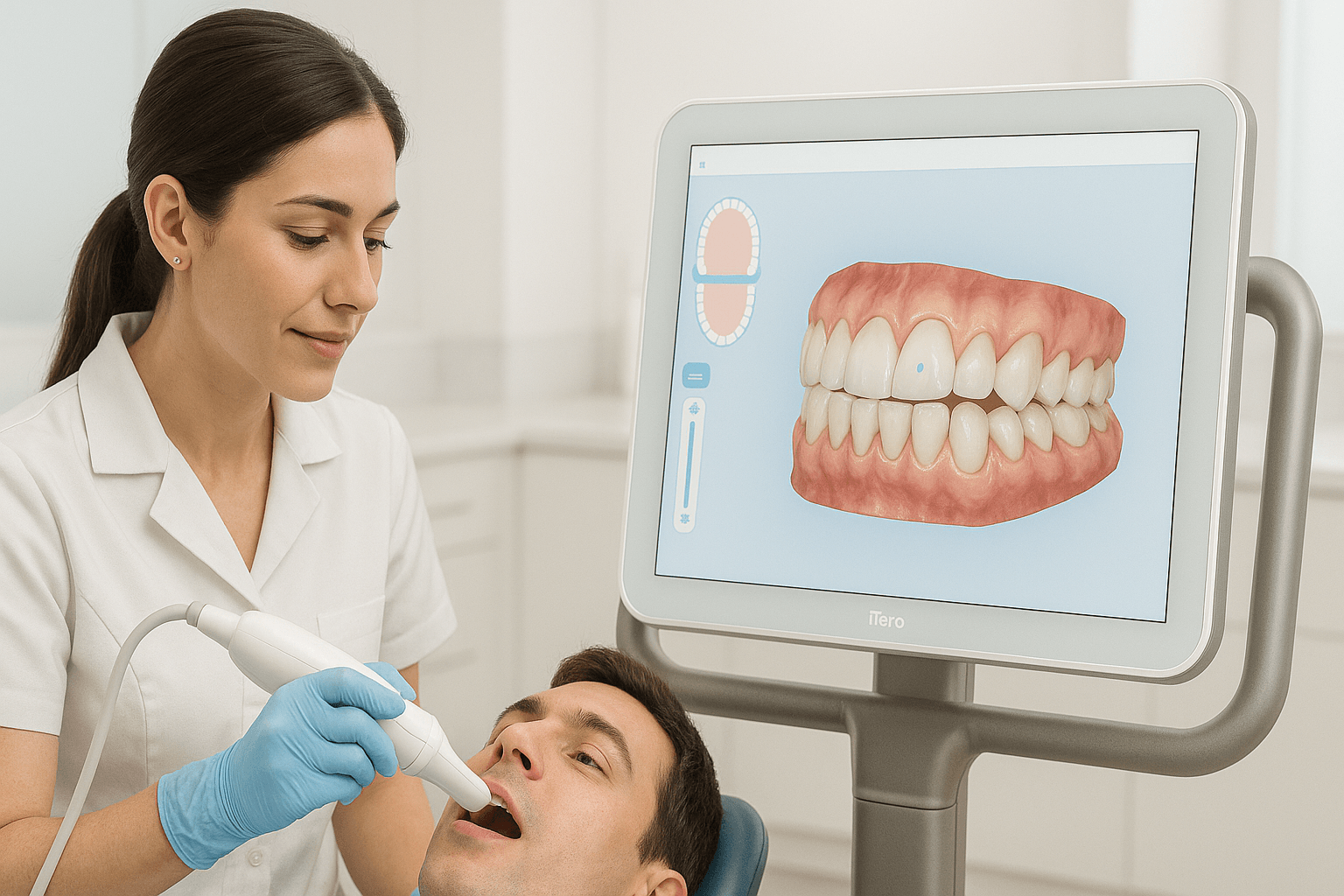
Digital orthodontic scan displayed during clear-aligner treatment planning

What Is Invisalign and How Does It Work?

Removable aligners and planned tooth movement

Invisalign treatment uses a sequence of clear, removable aligners. Each stage follows the treatment plan, and you change your aligners according to the schedule prescribed for your individual treatment.

What digital planning can and cannot tell you

Digital planning tools can help the clinician design intended tooth movements and show a simulation of the treatment plan. That simulation is a planning tool, not a guarantee that your teeth will move exactly as shown. Actual progress still needs clinical monitoring, and treatment may need to be reassessed or changed if progress differs from the plan. [ 4, 5, 2 ]

Who May Be Suitable for Invisalign?

There is no simple checklist that can tell you whether Invisalign is right for you. Suitability depends on the treatment your teeth and bite actually need — not just whether a case sounds “mild” or “complex.”

What determines whether Invisalign may suit you?

The important questions are what needs to move, how your bite is involved, what the treatment is intended to achieve, and whether aligners are appropriate for that plan.

Your ability to wear removable aligners as prescribed also matters.

When might another approach be considered?

Some people have more than one reasonable treatment option. In other situations, another orthodontic appliance, additional treatment measures or a different sequence of care may be more appropriate.

Ask why Invisalign is being recommended for your case and what realistic alternatives were considered.

Compare Invisalign and braces →

Adults, teens and children

Adults May be considered when Invisalign is clinically appropriate for the diagnosis and treatment plan.
Teenagers May also be considered when appropriate, but reliable aligner wear is an important part of treatment.
Younger children Treatment timing should follow dental development and treatment need, rather than age alone.

Invisalign First is a separate Phase 1 treatment option for growing children. [ 2, 12, 17 ]

Read more about Invisalign First for children →

What Invisalign Treatment Usually Involves

Every treatment plan is different, but most Invisalign journeys involve the same four broad stages: assessment, preparation, wearing the aligners, and checking how treatment is progressing.

1

Assessment and planning

Before treatment starts, your clinician needs enough information to understand your teeth, bite and treatment goals. Depending on your case, this may include photographs, scans or dental models, and X-rays when they are clinically needed. [8,9]

You should also understand what the treatment is trying to correct, why Invisalign is being considered, what other options may be reasonable, and what limitations apply to your case.

What this means for you: you should come away understanding your treatment goal — not just how the Invisalign system works.
2

Extra features that may be part of your plan

Some Invisalign plans use small tooth-coloured attachments bonded to selected teeth. These can help the aligners grip the teeth and produce particular movements. Elastics may also be used in some cases.

Your clinician may also recommend interproximal reduction (IPR). This means carefully creating a small amount of space between selected teeth when the treatment plan requires it. [6,7,2]

Useful question to ask: “Will I need attachments, elastics or IPR — and what is each one for?”
3

Wearing and changing your aligners

Invisalign is commonly prescribed for about 20–22 hours of wear each day. You then change to the next aligner according to the schedule your clinician has prescribed for your individual treatment. [3]

Do not assume that another person’s change schedule applies to you. Follow the instructions given for your own treatment.

Your part matters: because the aligners are removable, wearing them as instructed is an important part of keeping treatment on track.
4

Checking progress and adjusting the plan

Invisalign treatment still needs regular clinical monitoring. Your treating team checks whether the teeth are moving as intended and whether the aligners are fitting and tracking properly.

If progress differs from the plan, treatment may need to be checked again and adjusted. That can include additional aligners or another change to the treatment plan.

There is no universal check-up interval: how often you are reviewed should depend on your individual treatment plan rather than a fixed schedule that applies to everyone.

Daily Life With Invisalign

Because Invisalign is removable, day-to-day life is different from wearing a fixed appliance. These are the practical points worth knowing before you start.

Eating and drinking

Aligners are removed for meals. Follow the care instructions you are given for drinks and for when to put the aligners back in.

Practical takeaway: build enough time into your routine to remove, replace and care for the aligners as instructed.

Cleaning your teeth and aligners

Because the aligners are removable, you can brush and floss without a fixed appliance in place.

Your teeth and aligners still need regular cleaning, so follow the care instructions provided for your aligners.

Useful habit: treat cleaning as part of the treatment routine, not something to think about only when the aligners look dirty.

Speech, discomfort and aligner problems

Temporary speech changes may occur while you adapt to aligners.

If discomfort is severe or persistent, or an aligner is lost, damaged or no longer fitting properly, contact the treating team. Do not skip ahead or change the aligner sequence unless the treating team advises you to. [ 10, 11 ]

When in doubt: contact the treating team rather than improvising with the aligner sequence.

Limitations, Risks and Oral-Health Considerations

Invisalign is still orthodontic treatment. Healthy teeth and gums, appropriate treatment planning and ongoing monitoring all matter before and during treatment.

Dental and gum health before and during treatment

Active tooth decay may need to be treated, and active gum disease stabilized, before orthodontic treatment begins. Existing fillings, crowns, implants, missing teeth or other dental work can also affect how treatment is planned or coordinated. [ 12, 13, 14, 15 ]

Useful question to ask: “Is there anything about my teeth, gums or existing dental work that needs attention before I start?”

Orthodontic risks and adverse effects

Clear aligner treatment can have orthodontic adverse effects involving the teeth, roots or supporting tissues. Your treating clinician should explain the risks relevant to your case before treatment begins. [ 13 ]

What matters: you should understand both the expected benefits and the important limitations or risks that apply to your own treatment.

Retainers After Invisalign

Retainers are used after active orthodontic treatment to help maintain corrected tooth positions.

The retainer type, wear schedule and follow-up plan should be individualized. [ 16 ]

Learn about retainers and orthodontic aftercare →

Invisalign, Other Clear Aligners and Braces: Where to Compare

Invisalign is one branded clear-aligner system. Other clear-aligner systems also exist, while braces are fixed appliances. Different approaches have different clinical and practical trade-offs, and the right choice depends on the treatment you need rather than one option being universally better.

Clear aligners
Want to understand aligners beyond Invisalign?

Use our clear-aligner guide to understand the broader clear-aligner treatment category rather than Invisalign specifically.

Explore the clear-aligner guide →
Invisalign vs braces
Deciding between Invisalign and braces?

Use the dedicated comparison guide for the treatment and day-to-day differences that may matter when discussing Invisalign and braces for your case.

Compare Invisalign and braces →

Invisalign Cost in Dubai

Invisalign prices can vary because treatment plans are not all the same. Your quote may depend on the treatment you need and on what is included, such as monitoring, additional aligners and retainers.

If price is your main question, use our dedicated Invisalign cost guide for the current pricing evidence and what to check in a written quote.

What to Ask Before Choosing an Invisalign Provider

Choosing where to have Invisalign treatment is not only about the brand of aligners or the price. It is also worth understanding who will assess you, how your treatment will be planned and monitored, and what happens if the original plan needs to change.

Who will diagnose, plan and oversee treatment?

Ask who is responsible for your diagnosis and treatment plan, who will review your progress, and who you should contact if an aligner stops fitting or something changes during treatment.

You could ask: “Who will plan my treatment and who will actually monitor me as it progresses?”

Why is Invisalign considered suitable, and what alternatives were considered?

Ask why Invisalign is being recommended for your particular teeth, bite and treatment goals. It is also reasonable to ask what its limitations are in your case and whether another orthodontic approach was considered.

You could ask: “Why do you think Invisalign suits my case, and what other options did you consider?”

How are monitoring, additional aligners and retention handled?

Find out how progress will be checked, what happens if your treatment needs to be adjusted, how additional aligners are handled, and what the plan is for retainers after active treatment.

You could ask: “If my teeth do not move as planned, what happens next, and what is included after treatment finishes?”
Choosing an orthodontist or provider in Dubai

See the broader factors LumiQuest suggests considering when comparing orthodontic care options.

How to choose orthodontic care in Dubai →
Looking at Invisalign reviews?

Use the dedicated reviews guide to understand how patient reviews can help — and what they cannot tell you about whether treatment is right for your case.

Explore the Invisalign reviews guide →

Invisalign in Dubai FAQs

Quick answers to some of the most common questions about Invisalign treatment, suitability and day-to-day care.

How do I know whether Invisalign is suitable for me?

Suitability depends on your diagnosis, the tooth movements and bite correction you need, your treatment goals, and whether you can wear the aligners as prescribed. A clinician needs to assess your individual case before deciding whether Invisalign, another aligner system, braces or another approach is appropriate.

How long do you need to wear Invisalign each day?

Invisalign aligners are commonly prescribed for around 20–22 hours per day. Your clinician should tell you how long to wear each aligner and when to change to the next one based on your treatment plan.

Can you eat normally with Invisalign?

The aligners are removable, so they are normally taken out for meals. Follow the instructions from your treating team about drinks, cleaning and when to put the aligners back in.

What happens if an aligner does not fit properly?

Contact your treating team if an aligner is damaged, lost or no longer fits as expected. Do not simply skip ahead or change the prescribed sequence without advice, because the next step may depend on why the aligner is not fitting properly.

Do you need retainers after Invisalign?

Yes. Retainers are used after active orthodontic treatment to help maintain the corrected tooth positions. The type of retainer, wear schedule and follow-up should be individualized for your treatment. You can learn more in our retainers guide .

Can teenagers or children use Invisalign?

Invisalign may be an option for some teenagers when it is clinically appropriate and they can wear the aligners reliably. For younger children, timing depends on dental development and the orthodontic problem being treated. Invisalign First is a separate treatment approach designed for selected early orthodontic cases. See our Invisalign First guide for more detail.

How do Invisalign and braces differ?

Invisalign uses removable clear aligners, while braces are fixed to the teeth during treatment. They differ in how they are worn, cared for and used clinically, and one is not automatically better for every case. For the detailed comparison, see our Invisalign vs braces guide .

About this guide

Clinical review
Dr. Joe Feghali — Orthodontist and Founder, LumiQuest Dental Circle

What the clinical review covered

The clinical review included Invisalign suitability and treatment planning; planned tooth movement and digital simulations; aligner wear and monitoring; attachments, elastics and interproximal reduction (IPR); oral-health considerations; orthodontic risks; retention after treatment; Invisalign use in teenagers and younger patients; and guidance about treatment oversight and provider choice.

How the clinical claims were checked

Clinical claims in this guide were selectively evidence-checked against relevant professional guidance and research. Sources used for publication were human verified; the quantitative Invisalign wear instruction and the safety proposition received independent second-human verification.

Clinical review 31 August 2026
Updated 1 September 2026

Looking for broader guidance on orthodontic treatment options in Dubai?

Explore orthodontic treatment guidance in Dubai →

Clinical Evidence and Sources

The numbered markers in this guide link to sources supporting specific clinical statements.

  1. Alhafi ZM, Hajeer MY, Alam MK, Jaber ST. Quality and stability of orthodontic treatment outcomes with clear aligners versus fixed appliances: a systematic review and meta-analysis. European Journal of Orthodontics. 2025;47(6):cjaf091. DOI: 10.1093/ejo/cjaf091 . PMID: 41127933.
  2. American Association of Orthodontists. Clear Aligners. Patient and professional guidance. Controlled source state checked 31 August 2026. American Association of Orthodontists .
  3. Invisalign. What to expect in your first two weeks with Invisalign clear aligners. April 2026. Invisalign .
  4. Sereewisai B, et al. The accuracy of virtual setup in simulating treatment outcomes in orthodontic practice: a systematic review. BDJ Open. 2023;9:41. DOI: 10.1038/s41405-023-00167-3 . PMID: 37640693.
  5. Matos KN, et al. Clinical, biomechanical, and digital factors associated with refinement after the first series of clear aligners: a systematic review. International Orthodontics. 2026;24(4):101211. DOI: 10.1016/j.ortho.2026.101211 . PMID: 42442043.
  6. Jedliński M, et al. Attachments for the Orthodontic Aligner Treatment—State of the Art—A Comprehensive Systematic Review. 2023;20(5):4481. DOI: 10.3390/ijerph20054481 . PMID: 36901488.
  7. British Orthodontic Society. BOS Statement: Interproximal reduction. 24 October 2016. British Orthodontic Society .
  8. British Orthodontic Society. Orthodontic Records: Collection and Management — 2022 Update. British Orthodontic Society .
  9. Kapetanović A, Oosterkamp BCM, Lamberts AA, Schols JGJH. Orthodontic radiology: development of a clinical practice guideline. La Radiologia Medica. 2021;126(1):72–82. DOI: 10.1007/s11547-020-01219-6 . PMID: 32462471.
  10. Baeshen HA, et al. The effect of clear aligners on speech: a systematic review. European Journal of Orthodontics. 2023;45(1):11–19. DOI: 10.1093/ejo/cjac018 . PMID: 35522548.
  11. American Association of Orthodontists. What is an Orthodontic Emergency? 16 February 2026. American Association of Orthodontists .
  12. British Orthodontic Society. When Should I Avoid Making an Orthodontic Referral? Controlled source state checked 31 August 2026. British Orthodontic Society .
  13. British Orthodontic Society. Risks of Orthodontic Treatment — Guidance on Informing Patients. 2024. British Orthodontic Society .
  14. British Orthodontic Society. LTO — Limited Treatment Orthodontics. Controlled source state checked 31 August 2026. British Orthodontic Society .
  15. Wertheimer MB, Kim LY, Park JH. Orthodontic perspective on treatment recommendations for missing maxillary incisors: A contemporary guideline. American Journal of Orthodontics and Dentofacial Orthopedics. 2026;169(5):559–567. DOI: 10.1016/j.ajodo.2025.12.003 . PMID: 42020010.
  16. Al-Moghrabi D, Littlewood SJ, Fleming PS. Orthodontic retention protocols: an evidence-based overview. British Dental Journal. 2021;230:770–776. DOI: 10.1038/s41415-021-2954-7 .
  17. Invisalign. Invisalign First™ / Invisalign Aligners for Kids. Official product information used in the controlled evidence set. Invisalign .

Tell Us What You're Looking For

Describe your dental concern or goal. We'll review your enquiry and follow up using the contact details you provide.

LumiQuest guidance is currently free for patients; clinic consultation and treatment charges are separate.

We ask for your consent before sharing your identifiable information with a clinic.

Type your country (e.g., “United Arab Emirates”) or its code (e.g., “+971”), then your number without the area code. WhatsApp only.
Please enter a valid phone number.
Advanced Options (optional)
JPG, JPEG, PNG, PDF, HEIC, WEBP (max 10MB each)