
Best-supported evidence
dental and dentoalveolar expansion—widening mainly through tooth position and the supporting tooth-bearing structures—plus selected bite changes.
Invisalign First can move teeth and widen dental arches in selected children, but it is not a universal Phase 1 treatment. It should not be assumed to widen the jaw skeletally or prevent later orthodontic treatment. The key question is whether it fits your child's diagnosed problem and treatment goal.
dental and dentoalveolar expansion—widening mainly through tooth position and the supporting tooth-bearing structures—plus selected bite changes.
exact digital movements, predictable skeletal growth modification or avoidance of later braces, aligners or another orthodontic phase.
wearing the aligners as prescribed, monitoring actual progress, watching how the aligners track as teeth erupt and having a clear fallback plan if treatment does not go as intended.
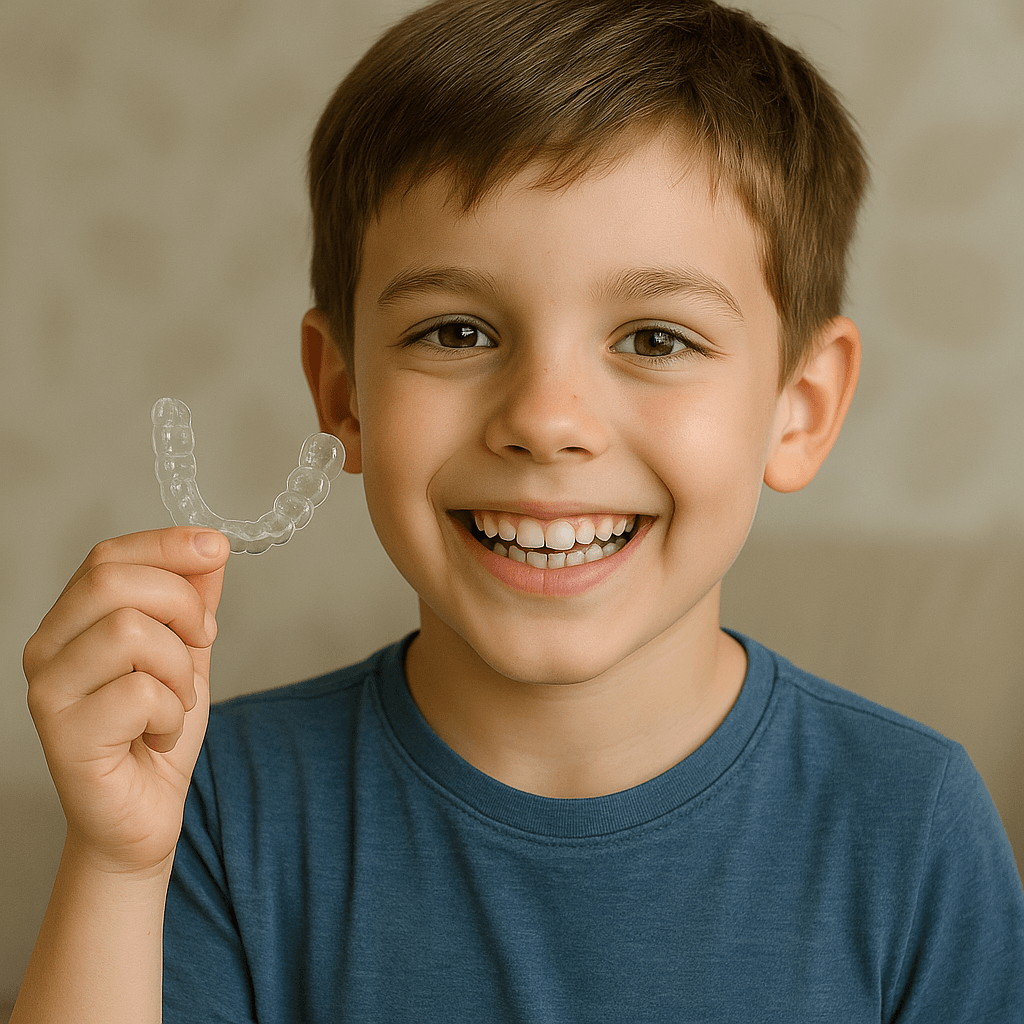
Invisalign First is Align Technology's clear-aligner product for Phase 1 orthodontic treatment during developing or mixed dentition, when a child has a combination of primary and permanent teeth. [16]
It is designed specifically for this stage of development, but being a certain age does not by itself make a child suitable.
Suitability depends on questions such as:
The manufacturer's product criteria and features help describe how Invisalign First is designed. They do not replace diagnosis or prove that the appliance is the right treatment for an individual child. [16]
Independent evidence shows that Invisalign First can produce measurable dental and dentoalveolar changes in selected children. The strongest current evidence is concentrated around arch expansion, with additional evidence for selected crowding, alignment and bite outcomes. [1–12]
That does not establish that Invisalign First works equally well for every Phase 1 problem.
The direct evidence is strongest for transverse arch development and expansion during mixed dentition.
Selected studies also report improvements in:
Those findings should remain tied to the problem and outcome studied.
An improvement in one bite measurement does not prove that Invisalign First will predictably correct every developing malocclusion.
Clear-aligner treatment begins with a digital treatment plan showing intended tooth movement.
But planned movement is not the same as achieved movement.
A 2026 systematic review and meta-analysis combined results from several Invisalign First studies to compare the expansion planned in the digital treatment plan with the expansion actually achieved. On average, the studies found that about:
Predictability was lower around the upper permanent first molars.
These figures describe the amount of planned expansion that was achieved across the included studies. They are not a general treatment-success rate and do not mean that an individual child has a 65% or 71% chance of successful treatment.
The practical message is simpler:
ClinCheck shows what is planned. Clinical monitoring is needed to determine what actually happens.
This distinction is one of the most important things for parents to understand.
This means widening occurs mainly through changes in the position of the teeth and their supporting tooth-bearing structures.
Current evidence supports Invisalign First most clearly in this area. [2–8]
This means meaningful change in the underlying jaw relationship itself.
Current Invisalign First evidence does not support a general statement that the appliance simply “expands the jaw.”
So if expansion is being recommended, the key clinical issue is whether the child's problem is:
That distinction can change which treatment approach makes sense.
Several studies have compared Invisalign First with conventional expansion appliances. In some of those comparisons, conventional expanders produced greater posterior and/or skeletal transverse changes. [2–6]
That does not make conventional expanders universally better.
It also does not make Invisalign First universally better because it is removable.
The comparison depends on what type and amount of expansion the child actually needs.
Selected children have shown increases in arch width and perimeter and reductions in crowding during Invisalign First treatment. [4,5,8,11,12]
That does not mean Phase 1 treatment provides complete orthodontic finishing.
A child may still have unerupted permanent teeth, residual crowding, alignment needs or bite problems after Phase 1.
Standard Invisalign First treatment is not established as predictable skeletal growth modification.
Children are naturally growing during treatment, and measured changes in the teeth, arches or cephalometric records cannot automatically be attributed to treatment-induced jaw growth. [8,9]
Moving teeth or reducing overjet is not the same as proving that the appliance predictably “grew the jaw.”
Class II usually refers to a relationship in which the upper teeth or jaw sit relatively forward compared with the lower teeth or jaw.
Align Technology also offers a separate Mandibular Advancement feature for selected growing Class II patients. [16]
The direct evidence specific to Invisalign First is preliminary.
One retrospective study included 17 growing patients overall, but only 7 were in the Invisalign First subgroup. [13]
That is not enough to establish predictable lower-jaw growth or universal Class II correction with Invisalign First.
If Mandibular Advancement is proposed, it matters whether the expected result is mainly:
Class III can include an underbite-type relationship in which the lower teeth or jaw sit relatively forward.
Robust independent evidence establishing Invisalign First as a general treatment for skeletal Class III malocclusion was not identified in the controlled evidence set.
That does not prove Invisalign First can never have a role in a selected Class III-related plan.
It means a broad claim that “Invisalign First corrects Class III in children” is not currently established.
Broader Class III assessment and treatment timing are covered on the Pediatric Orthodontics in Dubai page.
Invisalign First includes manufacturer-defined features intended to accommodate erupting teeth, including eruption compensation and product-specific planning around developing dentition. [16]
That describes how the product is designed.
It does not prove that Invisalign First:
The practical demands matter because Invisalign First is removable treatment.
Current Invisalign manufacturer instructions recommend approximately 20–22 hours of wear per day. [17,18]
That figure is a manufacturer instruction, not an independently validated Invisalign First success threshold.
Following the prescribed wear schedule matters, but wearing the aligners for 20–22 hours does not guarantee that every planned movement will occur exactly as intended.
Families should consider whether the child can realistically:
Manufacturer instructions require the aligners to be removed for:
That means school lunches, snacks, storage and re-insertion need to be manageable.
Removability gives normal physical access to the teeth for brushing and flossing.
It does not, by itself, prove that Invisalign First produces fewer cavities, healthier gums or better oral-health outcomes than other orthodontic treatments.
Attachments are small tooth-coloured shapes bonded to selected teeth to give the aligner additional engagement for certain movements.
Invisalign First includes product-specific attachment designs. [16,17]
One retrospective study found that attachment use was associated with greater expansion predictability for some posterior upper teeth. [7]
That does not mean every child needs attachments or that an attachment guarantees the programmed movement.
The useful point for parents is to understand what movement an attachment is intended to support and how that movement will be monitored.
There is no single evidence-based Invisalign First treatment duration for every child.
Published studies vary substantially because they treated different problems and objectives. [3–14]
Manufacturer workflow estimates are also not guaranteed treatment durations. [16]
The meaningful endpoint is therefore not simply a number of months. It is whether the defined Phase 1 objective has been achieved.
One small cross-sectional study reported higher appliance acceptance with Invisalign First than with removable acrylic appliances, including differences relating to speaking and appearance. [15]
That comparison was not against fixed braces or every other Phase 1 treatment.
It therefore does not establish that Invisalign First is universally:
Acceptability and treatment effectiveness are different questions.
Treatment progress should be judged against what is actually happening clinically, not simply whether the next digital stage looks correct.
Monitoring can include:
If an aligner persistently stops fitting closely over the teeth, or the teeth stop following the planned sequence, actual tooth movement may no longer match the digital plan.
Persistent poor seating or tracking should trigger clinical reassessment. [1,7,18]
There is no governed universal self-directed rule telling a parent to automatically:
Those decisions depend on the child's actual clinical position.
Contact the treating clinician rather than guessing which aligner should be used.
Official Invisalign use-and-care guidance states that, depending on the treatment status, the clinician may advise:
There is no one option that is correct in every situation.
It helps to tell the treating team:
Yes.
The initial aligner series does not always achieve every planned objective. Additional aligners or revised planning may be needed. [12,16]
That does not automatically mean treatment has “failed.”
The next step depends on why the objective was not fully achieved.
Possible reasons include:
One small case series reported a 69% first-series completion figure. [12]
That number must not be interpreted as a population-wide Invisalign First success rate, completion rate or refinement rate.
The study was too small and uncontrolled to establish such a probability.
Reassessment is the controlling response.
Depending on the clinical findings, the next step may involve:
The important principle is that treatment should not simply continue indefinitely on the assumption that the original sequence will eventually work.
Completing Invisalign First does not guarantee that later braces, aligners or other comprehensive orthodontic treatment will be unnecessary. [11,12,16]
It also does not mean later treatment is inevitable.
Phase 1 may address one defined problem while other orthodontic needs become clearer as more permanent teeth erupt.
Parents should understand:
Current governed evidence does not establish that Invisalign First generally prevents:
That does not mean those treatments will necessarily be needed.
It means prevention claims should not be accepted simply because treatment started early.
Selected observational studies suggest that some transverse and bite changes remained present for 18 months to two years and through part of the transition toward permanent dentition. [10,11,14]
That is useful evidence of selected maintenance.
It does not establish universal long-term stability.
Children continue to:
There is no single post-Phase-1 retention protocol established for every Invisalign First child.
Selected stability findings do not prove that retention is unnecessary. [10,14,16]
Depending on the child's developing dentition, the next stage may involve:
For broader retention guidance, see Retainers in Dubai .
Do not compare treatment plans by appliance name alone.
What problem is actually being treated?
What is the plan intended to change during Phase 1?
Is the intended change mainly dental/dentoalveolar or skeletal?
What evidence supports that particular treatment objective?
What wear and day-to-day cooperation does the treatment require?
How will actual progress be checked during treatment?
Could additional aligners or another treatment change be needed?
What happens if the planned objective is not achieved?
Could comprehensive orthodontics still be required later? [1–4]
For example, some conventional expanders produced greater posterior or skeletal changes in comparative studies, while Invisalign First produced useful dental/dentoalveolar expansion in selected children. [2–6]
Those findings do not create one universal winner.
Current evidence also does not establish Invisalign First as universally superior to:
Different treatments may be designed to solve different problems.
A useful treatment discussion should make the diagnosis, objective, day-to-day demands, monitoring and fallback plan clear.
Ask:
Clarify whether the quoted scope includes or separates:
This is a scope clarification checklist, not a statement about what Dubai providers normally include.
No component should be assumed to be included unless the provider confirms it.
For detailed numerical orthodontic pricing guidance, see Orthodontics Cost in Dubai .
Parents may also ask:
LumiQuest may provide provider guidance and provider navigation to help patients understand these questions and navigate toward suitable dentists or clinics.
It does not provide a public provider ranking or guarantee that a particular clinician or clinic is suitable for an individual child.
LumiQuest Dental Circle is an independent dental guidance platform.
It may help patients and parents understand options and navigate toward suitable dentists or clinics.
It is not a dental clinic, treatment provider, public provider-ranking directory or paid-ranking marketplace.
This guide is intended to help parents understand what Invisalign First has actually been studied for, distinguish digital planning from achieved movement, interpret expansion and growth claims, understand the practical demands of treatment and ask more useful questions before agreeing to care.
It does not replace an individualized orthodontic diagnosis or treatment plan.
References were selected for the specific clinical claims cited in this guide. Manufacturer sources [16]–[18] are used only within the source-role limits stated below.
Describe your dental concern or goal. We'll review your enquiry and follow up using the contact details you provide.
LumiQuest guidance is currently free for patients; clinic consultation and treatment charges are separate.
We ask for your consent before sharing your identifiable information with a clinic.
Enquiring about dental care for a child? Please have a parent or legal guardian submit the enquiry. We may ask for the child's age during follow-up if it is relevant to understanding the care being sought.
LumiQuest uses necessary cookies and similar technologies for website functionality and security. With your permission, we also use Google Analytics to understand how visitors use our website. You can accept or deny optional analytics cookies, view your preferences, and change your choice later using Manage consent. Read our Privacy Policy for more information.