TMJ Specialist in Dubai — Expert Evaluation for Jaw Joint Disorders
Seeing a TMJ specialist in Dubai is not about quick splints or guesswork. It’s about accurate diagnosis of jaw joint function, muscles, bite mechanics and contributing factors — especially when pain, clicking or headaches persist.
LumiQuest focuses on clinical evaluation, not assumptions. Instead of default appliances or rushed referrals, we help patients understand what TMJ disorders actually involve, when specialist care is appropriate, and how conservative-first management protects long-term jaw stability. Start with the TMJ overview to understand symptoms, causes, and when escalation is truly needed.

Muscles, joints, bite and neuromuscular balance

Avoiding unnecessary splints or surgery

Function, comfort and joint health over time

What a TMJ Specialist Evaluates
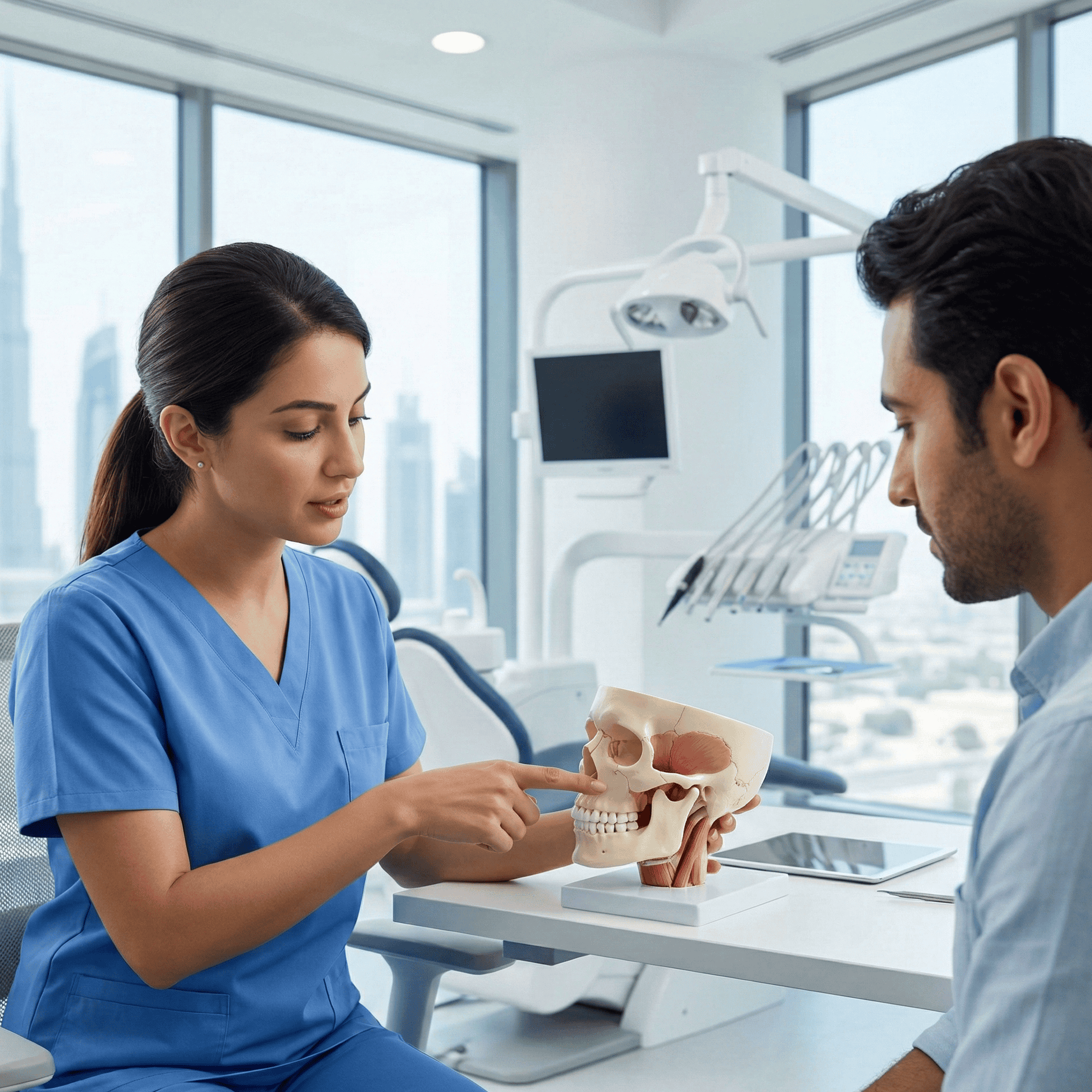
TMJ disorders are rarely caused by a single issue. A TMJ specialist evaluates the jaw joints, muscles, bite mechanics and neuromuscular coordination together — not in isolation.
Jaw Joint Function
Evaluation of how the temporomandibular joints move, load and glide during opening, closing and chewing.
Clicking, popping or locking may signal joint stress — not always damage.

Muscle Balance & Tension
Assessment of the jaw, neck and facial muscles for overactivity, fatigue or asymmetry.
Muscle-driven TMJ symptoms are common and often reversible.
Bite & Occlusion
Analysis of how your teeth meet, slide and distribute force during function — especially in cases of clenching or grinding.
Bite imbalance can overload joints even without visible tooth damage.
Neuromuscular Coordination
Evaluation of how the brain, muscles and joints coordinate jaw movement — including posture, habits and stress-related patterns.
Many TMJ symptoms worsen under stress or fatigue.
Not every patient needs scans, splints or referrals. A TMJ specialist’s role is to determine what matters — and what doesn’t — before any treatment is proposed. If symptoms are mild or situational, start with the TMJ overview.
When to See a TMJ Specialist
Not all jaw noises or discomfort require specialist care. A TMJ specialist is most helpful when symptoms are persistent, worsening or unclear — especially after basic dental care hasn’t resolved the problem.
1. Jaw Pain That Persists or Escalates
Ongoing pain during chewing, speaking or resting — especially if it lasts weeks or months — deserves deeper evaluation.
Short-lived soreness can be normal; chronic pain is not.
If jaw pain is sudden, severe, or associated with trauma, swelling, fever, or difficulty opening, an emergency dentist may be more appropriate than waiting for specialist evaluation.
2. Locking, Catching or Limited Opening
Difficulty opening fully, sudden locking, or a feeling that the jaw “catches” may indicate joint mechanics issues.
These signs should not be ignored if recurrent.
3. Headaches, Ear Symptoms or Facial Pain
TMJ-related problems can refer pain to the temples, ears, neck or face, often mimicking sinus or neurological issues.
A TMJ specialist helps rule out dental causes before escalation.
4. Failed or Unclear Previous Treatment
If splints, exercises or adjustments were tried without clear improvement — or without a clear diagnosis — specialist reassessment is appropriate.
Repeating the same approach rarely fixes the problem.
When You May Not Need a Specialist Yet
- Occasional, painless clicking without limitation
- Temporary jaw fatigue after stress or long chewing
- Mild symptoms that improve with rest or habit awareness
In these cases, starting with the TMJ overview or routine dental assessment is often sufficient.
A TMJ specialist’s role is not to escalate treatment — it’s to clarify what’s driving your symptoms and whether conservative care is enough. Surgical pathways, if ever needed, are considered only after careful diagnosis.
TMJ Specialist vs General Dentist — What’s the Difference?
Both general dentists and TMJ specialists play important roles. The difference lies in depth of evaluation, complexity management and decision-making scope — not in quality or competence.
General Dentist
- Initial assessment of jaw pain or clicking
- Identifies obvious dental causes (tooth pain, decay, infection)
- Basic advice on clenching, grinding and habits
- May provide simple splints or monitoring
Ideal starting point for mild, early or unclear symptoms.
TMJ Specialist
- Detailed evaluation of joints, muscles, bite and neuromuscular patterns
- Differentiates joint-driven vs muscle-driven disorders
- Assesses failed or worsening cases
- Coordinates conservative care, imaging or referrals when needed
Appropriate when symptoms are persistent, complex or unresolved.
Seeing a TMJ specialist does not mean surgery is planned or inevitable. In many cases, the outcome is clarity, reassurance and conservative guidance — not escalation.
Conservative-First TMJ Treatment Philosophy
Most TMJ disorders do not require aggressive intervention. A responsible TMJ specialist prioritises reversible, low-risk and evidence-based care before considering permanent or invasive options.
Avoiding Irreversible Decisions Early
Permanent changes to bite, joints or anatomy should never be the first step. Conservative care allows symptoms to settle before committing to decisions that cannot be undone.
Diagnosis Before Devices
Appliances, splints or referrals should follow a clear diagnosis — not precede it. Understanding what is driving symptoms prevents overtreatment.
Time as a Diagnostic Tool
Many TMJ symptoms improve with time, habit changes and muscle adaptation. A conservative approach respects the body’s ability to stabilise without forceful intervention.
Escalation Only When Necessary
Imaging, multidisciplinary input or surgical pathways are considered only when symptoms are persistent, progressive or disabling despite conservative care.
A conservative-first philosophy does not mean ignoring symptoms — it means choosing the least invasive path that restores comfort and function. When escalation is needed, it is done deliberately, not reactively.
How LumiQuest Assesses TMJ Specialist Care
TMJ care requires restraint, judgment and clarity — not aggressive treatment plans. LumiQuest assesses TMJ specialists using clinical decision-making criteria, not visibility, advertising or volume.
Diagnostic Clarity
Does the specialist clearly explain whether symptoms are joint-driven, muscle-driven or bite-related — and acknowledge uncertainty when appropriate?
Conservative Decision-Making
Are reversible, low-risk options prioritised before appliances, imaging or referrals?
Reasoned Use of Imaging
Imaging is used to answer specific diagnostic questions, not as a default step for every patient.
Multidisciplinary Judgment
When needed, care is coordinated thoughtfully — recognising when physiotherapy, stress management or surgical opinion is appropriate or unnecessary.
Transparent Communication
Patients are informed about uncertainty, timelines and expectations, rather than rushed into plans framed as urgent or inevitable.
Follow-Up & Reassessment
Care plans allow for re-evaluation over time, recognising that TMJ symptoms often evolve rather than resolve instantly.
LumiQuest does not publish public rankings or clinic lists. Patients receive private guidance toward specialists who meet our criteria for judgment, restraint and patient-centered care — independent of marketing or paid visibility.
FAQs: TMJ Specialist in Dubai
Clear answers to common questions about seeing a TMJ specialist in Dubai — including diagnosis, imaging, treatment philosophy and when specialist care is truly needed.
What does a TMJ specialist do differently from a general dentist?
A TMJ specialist focuses on jaw joints, muscles, bite mechanics and neuromuscular coordination together. While general dentists manage early or mild symptoms, specialists assess persistent, complex or unclear cases and guide conservative-first care.
When should TMJ symptoms be evaluated by a specialist?
Specialist evaluation is appropriate when symptoms are ongoing, worsening, recurrent, or have not improved with basic dental care. Locking, limited opening, chronic pain or associated headaches are common reasons.
Are TMJ specialists focused on non-surgical treatment first?
Yes. Responsible TMJ specialists prioritise reversible, conservative and low-risk approaches. Surgical pathways are considered only when clearly indicated and after conservative options are exhausted.
Can a TMJ specialist help with headaches or facial pain?
TMJ disorders can refer pain to the temples, face, ears and neck. A TMJ specialist helps determine whether symptoms are jaw-related or require referral to another discipline.
Do TMJ specialists treat teeth grinding and jaw clenching?
Yes — but only when these habits are confirmed contributors. Treatment focuses on reducing overload and muscle strain, not simply masking symptoms with appliances.
Will I need imaging to diagnose TMJ disorders?
Not always. Imaging is used selectively to answer specific diagnostic questions. Many TMJ cases can be managed based on clinical evaluation alone.
When is surgical referral considered for TMJ problems?
Surgical referral is uncommon and considered only for severe, persistent or structurally driven conditions that do not respond to conservative care.
If you’re unsure whether specialist care is needed, start with the TMJ overview to understand symptoms and next steps calmly.
What is LumiQuest?
LumiQuest is an independent patient guide that helps you navigate TMJ disorders and jaw pain in Dubai. We focus on diagnostic clarity, conservative care and long-term jaw stability — especially when symptoms affect chewing, comfort, sleep or daily function.

No Ads. No Sponsorships.
LumiQuest does not accept paid listings or promotions. Guidance is based on diagnostic accuracy, conservative-first care and clinical judgement — never on marketing visibility, trendy treatments or financial incentives.

Clinics Vetted for TMJ Evaluation
Clinics are assessed for examination quality, diagnosis logic and escalation restraint. We prioritise providers who explain uncertainty clearly, avoid overtreatment and focus on muscle balance, joint protection and functional recovery.

A Private Circle of Trust
Only clinics that consistently demonstrate clinical honesty, conservative judgment and follow-through remain in our circle. LumiQuest helps you access care that prioritises relief without harm, clarity without pressure — not rushed splints, unnecessary injections or premature surgical pathways.
✔ Guidance grounded in safety, ethics, and real-world signals — in Dubai
Your smile deserves clarity, trust, care — and privacy
No ads · No sponsored spots · 100% patient-first · Fully confidential
Find Safe, Trusted TMJ Care in Dubai
When jaw pain affects chewing, sleep, headaches or daily comfort, the plan should be careful — and the diagnosis should be clear. LumiQuest connects you with vetted, ethical providers in Dubai who prioritise conservative-first TMJ care, proper evaluation and long-term jaw stability — without pressure, upselling, or rushed irreversible treatment.
Get Clear Guidance to the Right Dentist
Just a couple of minutes — no pressure, no cost, and fully private
One of our advisors will review your request and guide you to a suitable dentist or clinic, usually within 12 hours.